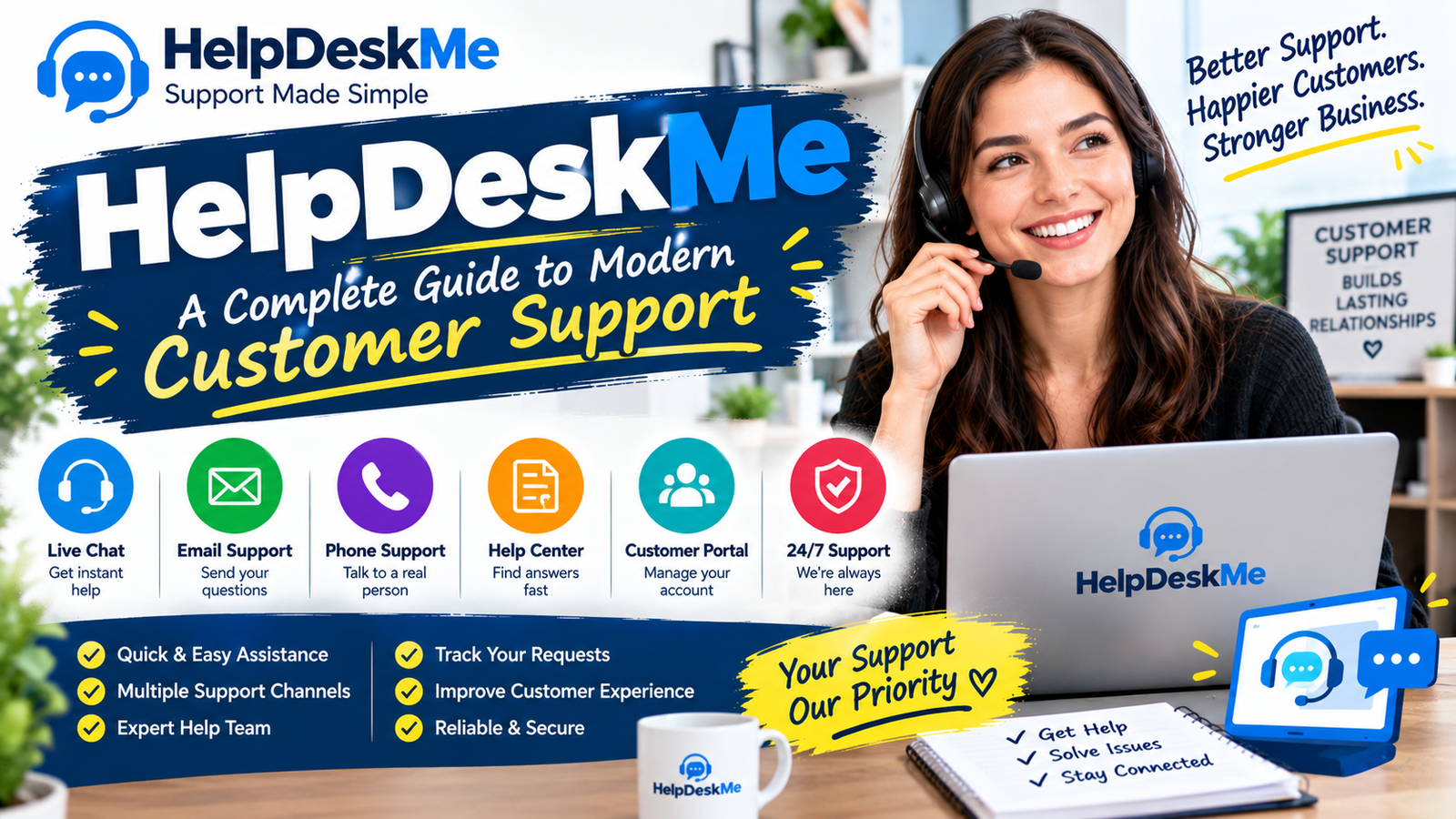
In today’s digital business environment, providing fast and reliable customer support is more important than ever. HelpDeskMe Customers expect businesses to answer questions quickly, resolve problems efficiently, and provide a smooth experience across different communication channels. This is where HelpDeskMe can play an important role.
HelpDeskMe is a customer support and ticketing platform designed to help businesses organize customer requests, automate repetitive support tasks, collaborate with support teams, and monitor performance. According to its website, the platform focuses on smart ticket management, workflow automation, team collaboration, analytics, and omnichannel support.
What Is HelpDeskMe?
HelpDeskMe is designed to simplify the process of managing customer support. Instead of handling customer questions through scattered emails, messages, and manual processes, businesses can organize support requests through a centralized ticketing system.
A ticket represents a customer question, complaint, technical problem, or service request. Support teams can prioritize these tickets, assign them to appropriate agents, track their progress, and close them after the issue has been resolved.
The main purpose of HelpDeskMe is to make customer service more organized and efficient while helping teams maintain visibility over their support operations.
Key Features of HelpDeskMe
HelpDeskMe provides several features intended to help modern support teams manage their daily workload.
Some of the major features include:
- Smart Ticket Management: Organize, prioritize, assign, and track customer requests from one place.
- Workflow Automation: Automate repetitive activities such as ticket assignment, status changes, reminders, and escalations.
- Team Collaboration: Allow support agents to share internal notes, collaborate on cases, and escalate issues when necessary.
- Advanced Analytics: Monitor ticket volumes, response times, customer satisfaction, and other support metrics.
- Omnichannel Support: Manage customer communication from channels such as email, chat, and social media.
- Knowledge Base: Provide customers with helpful articles and frequently asked questions for self-service support.
- Integrations: Connect support workflows with other business applications and tools.
- Cloud-Based Access: Give teams access to support operations without depending on a traditional local system.
How HelpDeskMe Works
A typical HelpDeskMe workflow begins when a customer submits a question or support request. The request can then be converted into a ticket and organized according to priority, category, or other business rules.
The general process can be summarized as follows:
- Customer submits a request – A customer contacts the business with a question or problem.
- Ticket is created – The request becomes a trackable support ticket.
- Ticket is assigned – The appropriate support agent or team receives the ticket.
- Issue is investigated – The support team reviews the customer’s information and identifies the problem.
- Customer receives a response – The agent provides an answer or requests additional information.
- Issue is resolved – Once the problem is solved, the ticket can be closed.
- Data is recorded – The support history remains available for future reference and analysis.
This structured approach can reduce the possibility of customer requests being forgotten or overlooked.
Why Businesses Need a Help Desk Platform
As a company grows, the number of customer questions usually grows as well. Managing every request manually can become difficult, especially when multiple agents are handling hundreds or thousands of conversations.
A help desk platform can bring customer communication into a central system. This makes it easier for managers to understand workloads, for agents to prioritize tasks, and for customers to receive more consistent assistance.
HelpDeskMe emphasizes reducing repetitive work through automation while providing teams with tools for collaboration and real-time insights.
Benefits of Using HelpDeskMe
There are several potential benefits of using a centralized support platform such as HelpDeskMe.
1. Better Organization
A ticketing system keeps customer requests organized. Agents can see which tickets are new, pending, assigned, or resolved.
2. Faster Responses
Automation and intelligent ticket routing can reduce unnecessary manual work. This allows support agents to spend more time addressing customer issues.
3. Improved Team Collaboration
Support problems sometimes require multiple people to work together. Shared notes, internal comments, and escalation features can help teams coordinate their efforts.
4. Greater Visibility
Analytics and dashboards can provide information about ticket volumes, response times, and customer satisfaction. Managers can use this information to identify areas that need improvement.
5. Better Customer Experience
When customers receive organized, timely, and consistent responses, they are more likely to have a positive experience with a business.
HelpDeskMe for Small Businesses
Small businesses often operate with limited staff and resources. Every employee may have several responsibilities, making manual customer support difficult to maintain.
HelpDeskMe can help smaller teams organize support requests and automate repetitive processes. The platform states that it is designed to work for both startups and larger enterprises, allowing support operations to scale as customer demand increases.
For a small business, even simple improvements—such as automatic ticket assignment or a searchable knowledge base—can reduce the workload on customer service employees.
HelpDeskMe for Growing and Enterprise Teams
Larger organizations typically need more structured support processes because they may receive a much higher volume of customer requests.
HelpDeskMe’s features for automation, analytics, collaboration, and centralized ticket management are intended to support larger and more complex customer service operations. The company’s website says the platform is designed for teams ranging from startups to enterprises.
With a centralized platform, managers can gain a clearer picture of support performance while agents can focus on resolving individual customer problems.
Automation and Customer Support
Automation is one of the most important elements of modern help desk software. Repetitive tasks can consume a significant amount of an agent’s working day.
HelpDeskMe promotes automation for activities such as ticket routing, status updates, escalations, and follow-ups. By establishing rules for routine processes, teams can reduce manual work and focus more attention on complicated customer issues.
However, automation should support human agents rather than completely replace human communication. Complex or sensitive customer problems often require understanding, judgment, and personal assistance.
Analytics and Performance Monitoring
Good customer support is not only about answering individual tickets. Businesses also need to understand how their support operation is performing.
Analytics can help teams examine:
- Average response times
- Number of incoming tickets
- Ticket resolution rates
- Customer satisfaction
- Agent performance
- Support backlogs
- Common customer problems
This information can help managers identify bottlenecks and make informed improvements to their support strategy.
Is HelpDeskMe Worth Considering?
For businesses searching for a centralized customer support solution, HelpDeskMe offers a combination of ticket management, automation, collaboration, analytics, knowledge-base functionality, and omnichannel support.
The right platform ultimately depends on a company’s team size, support volume, budget, integrations, security requirements, and customer service goals. Businesses should evaluate these factors before selecting any help desk solution.
Final Thoughts
HelpDeskMe represents a modern approach to organizing customer support. By bringing tickets, automation, collaboration, analytics, and customer communication into a structured environment, a help desk platform can make support operations easier to manage.
For small businesses, it can provide organization as the company grows. For larger teams, automation and analytics can help manage more complex support operations. Most importantly, a well-designed help desk system can help businesses deliver faster and more consistent customer experiences.
As customer expectations continue to rise, companies need more than simply an email inbox for handling support requests. Tools such as HelpDeskMe can provide the structure, automation, and visibility needed to build a more efficient customer support process.